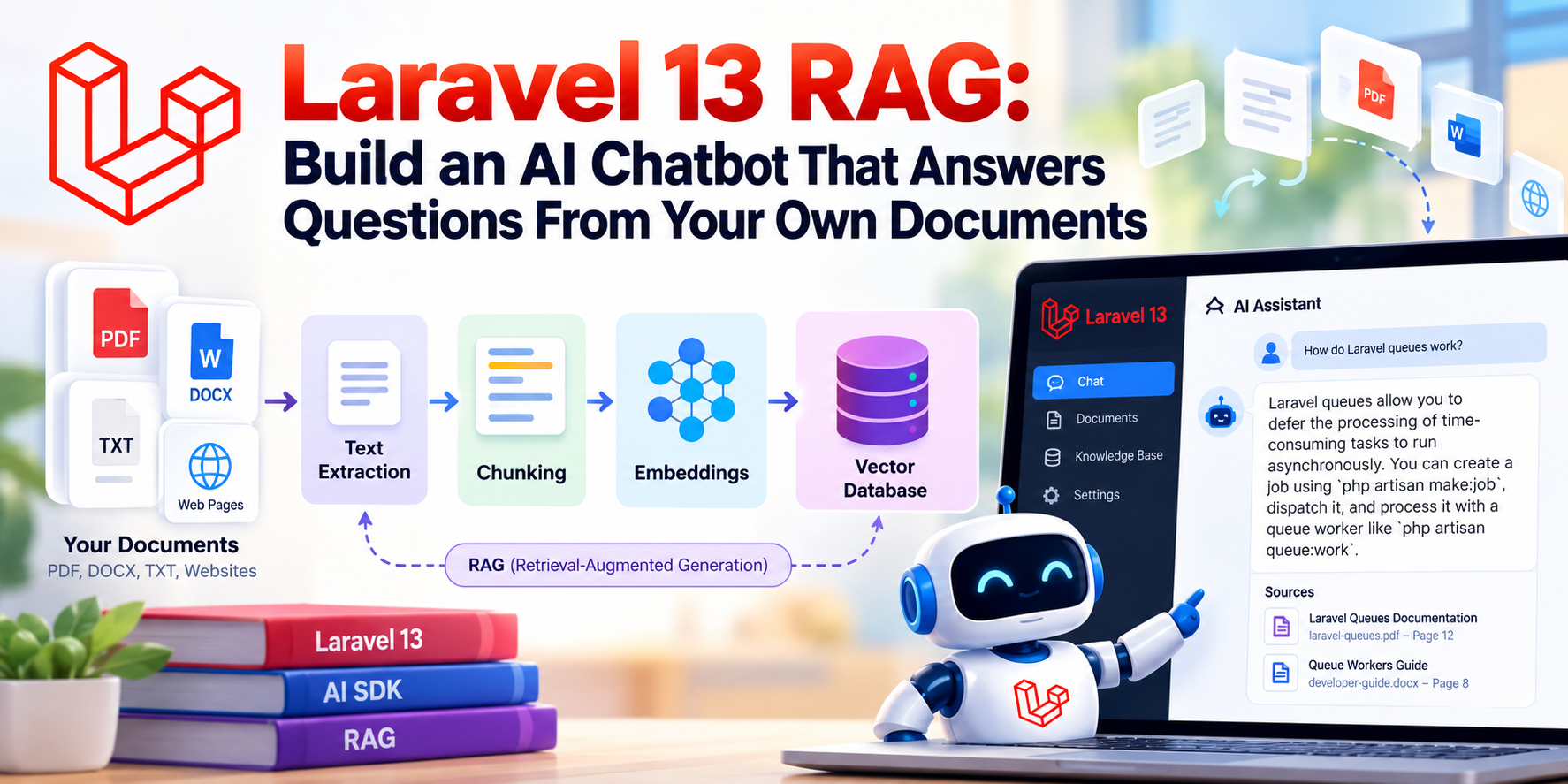
AI chatbots are easy to build. The difficult part is making an AI chatbot answer questions using your own private and constantly changing data. Imagine uploading your company's documentation, product manuals, support articles, PDFs, policies, or internal knowledge base and then asking: "What is our refund policy for annual subscriptions?" A traditional AI model may not know the answer. This is where RAG — Retrieval-Augmented Generation comes in. With RAG, we can build a Laravel 13 application that retrieves relevant information from our own documents and gives that information to an AI model before generating the final answer. In this tutorial, we'll explore how to build a document-aware AI chatbot using Laravel 13.
What Is RAG?
RAG stands for Retrieval-Augmented Generation. Instead of sending a user's question directly to an AI model, a RAG system follows a process like this:
User Question
      ↓
Generate Query Embedding
      ↓
Search Vector Database
      ↓
Find Relevant Document Chunks
      ↓
Add Relevant Context
      ↓
Send Context + Question to AI
      ↓
Generate Answer
The AI isn't expected to know everything. Instead, we give it the most relevant information from our own data. For example, suppose your application contains a 200-page company policy document. A user asks:
How many days do I have to request a refund?
The RAG system searches the document, finds the relevant section, and sends it to the AI. The model can then answer based on the retrieved content.
Why Use RAG With Laravel?
Laravel is already excellent for building:
- APIs
- Authentication
- File uploads
- Queued jobs
- Database applications
- Admin panels
- SaaS applications
Adding RAG gives Laravel applications an AI-powered knowledge layer.
You can build:
- Documentation assistants
- Customer support bots
- Internal knowledge assistants
- AI HR assistants
- Legal document search
- Product support bots
- PDF chat applications
- Educational assistants
- Company knowledge bases
- AI-powered search
RAG vs Fine-Tuning
One common question is:
Why not simply fine-tune the AI model with our documents?
Fine-tuning and RAG solve different problems.
RAG
*Retrieves information at runtime *Excellent for private documents *Easy to update knowledge *Can provide document sources *Good for frequently changing data
For a knowledge base that changes frequently, RAG is usually a much better starting point.
How a Laravel RAG System Works
A typical Laravel RAG architecture looks like this:
.                     Laravel 13
                        │
            ┌───────────┴───────────┐
            │                       │
      Document Upload          Chat Interface
            │                       │
            ↓                       ↓
      Text Extraction           User Question
            │                       │
            ↓                       ↓
        Chunking                Embedding
            │                       │
            ↓                       ↓
       Embeddings ───────→ Vector Search
                                    │
                                    ↓
                           Relevant Chunks
                                    │
                                    ↓
                              AI Model
                                    │
                                    ↓
                               AI Answer
There are four major stages:
- Ingestion
- Embedding
- Retrieval
- Generation
Ingestion
Your documents are uploaded, their text is extracted, and the content is split into smaller chunks.
Embedding
Each chunk is converted into a numerical vector that represents its meaning and is stored in a vector database.
Retrieval
When a user asks a question, the system searches the vector database to find the most relevant chunks.
Generation
The relevant information is sent to the AI model along with the user's question, and the AI generates a contextual answer.