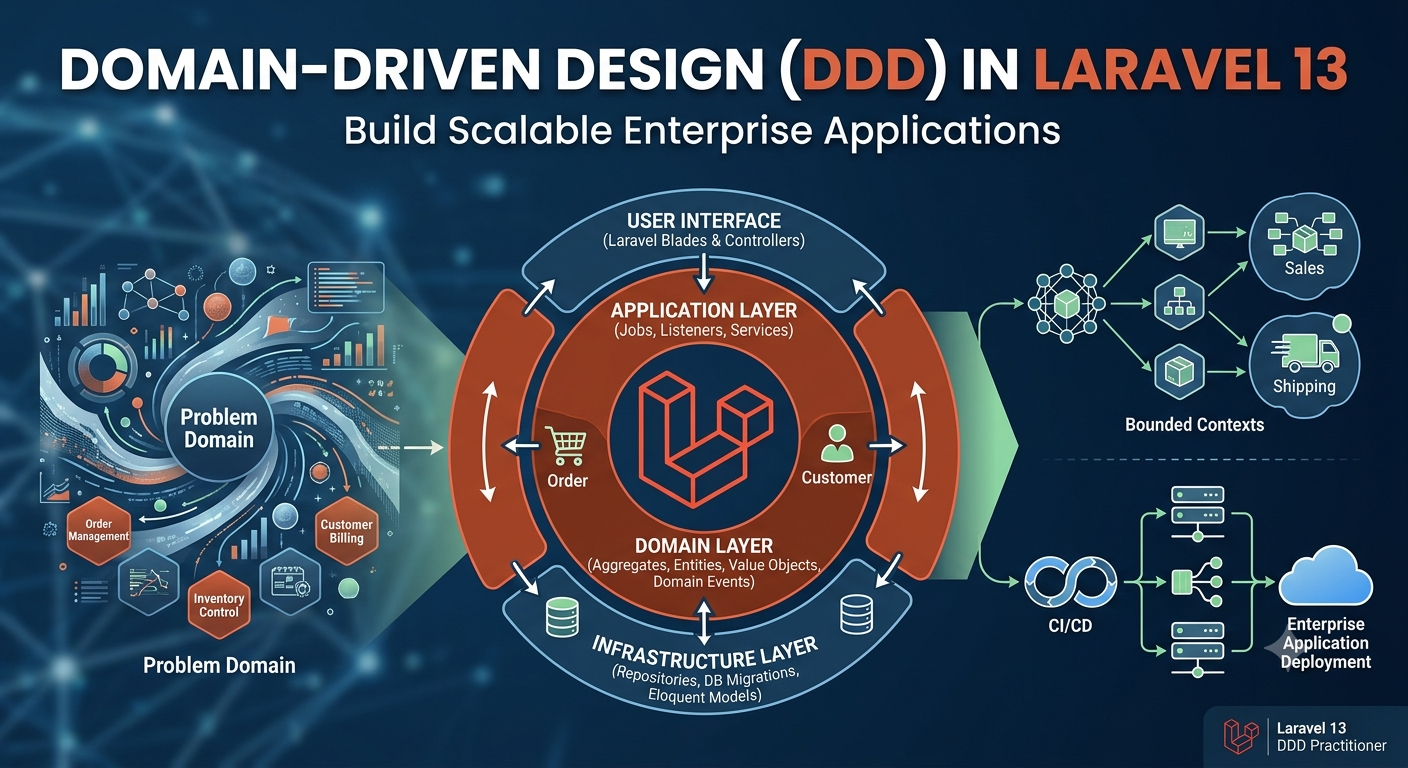
As Laravel applications grow, placing all business logic inside controllers and models becomes difficult to maintain. This often leads to fat controllers, fat models, duplicated logic, and code that's hard to test.
Domain-Driven Design (DDD) solves these problems by organizing your application around the business domain, making your code more modular, reusable, and easier to maintain.
In this article, we'll explore how to implement DDD in Laravel 13 using a practical example.
What is Domain-Driven Design (DDD)?
Domain-Driven Design is a software development approach introduced by Eric Evans in his book Domain-Driven Design: Tackling Complexity in the Heart of Software.
Instead of organizing code by Laravel components (Controllers, Models, Requests), DDD organizes code by business capabilities.
For example:
Instead of:
app/
    Models/
    Controllers/
    Services/
You organize by domain:
app/
└── Domains/
    ├── User/
    ├── Product/
    ├── Order/
    └── Payment/
Each domain contains everything related to that business feature.
Benefits of DDD
- Cleaner project structure
- Easier testing
- Better code organization
- Business logic separated from Laravel
- Easier team collaboration
- Highly scalable architecture
- Reusable domain logic
Recommended Laravel 13 DDD Folder Structure
app
│
├── Domains
│   └── Product
│       ├── Entities
│       ├── Repositories
│       ├── Services
│       ├── ValueObjects
│       ├── DTOs
│       └── Exceptions
│
├── Http
├── Models
└── Providers
Every business module lives inside its own folder.
Example: Product Module
Suppose you're building an eCommerce application.
Instead of placing everything inside the Product model, create a dedicated domain.
Domains
└── Product
    ├── Entities
    │     Product.php
    ├── Repositories
    │     ProductRepository.php
    ├── Services
    │     ProductService.php
    └── DTOs
          CreateProductData.php