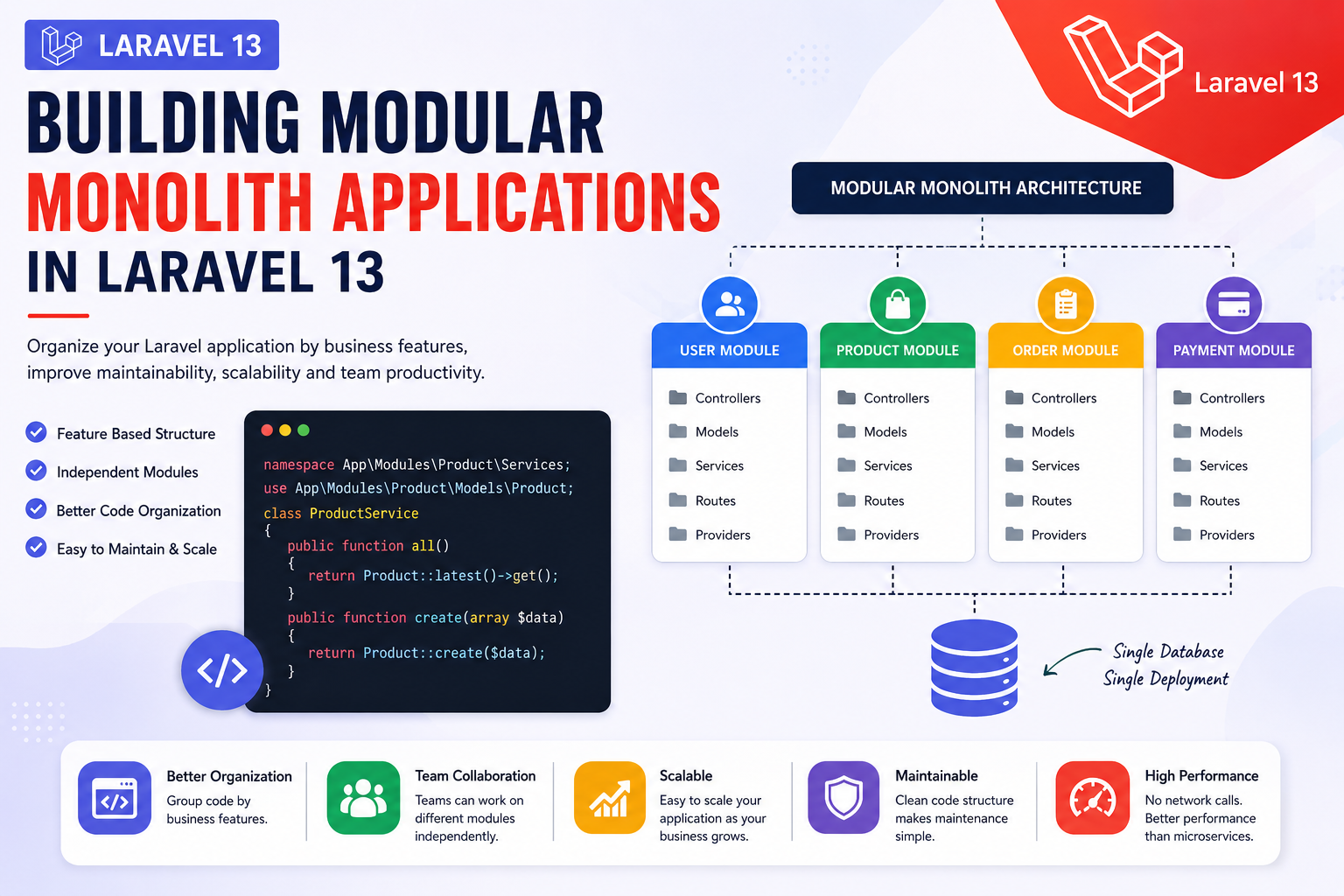
As Laravel applications grow, managing everything inside a single app/ directory becomes difficult. Controllers become huge, services get mixed together, and maintaining business logic becomes increasingly challenging.
A Modular Monolith solves this problem by organizing the application into independent business modules while still deploying as a single Laravel application.
Unlike microservices, there is:
- No network communication
- No distributed transactions
- No multiple deployments
- Easier debugging
- Better performance
Laravel 13 makes this architecture easier than ever with improved service providers, dependency injection, routing, and auto-discovery.
What is a Modular Monolith?
Instead of organizing your project by technical layers like:
Controllers
Models
Services
Repositories
Policies
Jobs
You organize everything by business features.
Example:
Users
Products
Orders
Payments
Inventory
Reports
Notifications
Each module contains everything related to itself.
Why Use Modular Architecture?
Better Code Organization
Everything related to Orders stays inside the Order module.
Easy Maintenance
Developers immediately know where to find code.
Team Collaboration
Different teams can work on separate modules without conflicts.
Reusability
Entire modules can be reused in future projects.
Enterprise Ready
Perfect for large SaaS applications and ERP systems.
When Should You Use a Modular Monolith?
This architecture is ideal for:
- SaaS platforms
- ERP systems
- CRM applications
- HR Management Systems
- E-commerce platforms
- Healthcare software
- FinTech applications
- Learning Management Systems (LMS)
- AI-powered recruitment platforms
- Enterprise business applications